Less is More บางครั้งการใช้สีมากเกินความจำเป็นอาจจะทำให้สไลด์ของเราดูรกตา แล้วดึงดูดความสนในจากเนื้อหาที่เราต้องการพรีเซนต์ เลือกใช้ความเข้มและอ่อนของข้อความเน้นความสำคัญเช่นหัวข้อ และเนื้อหาตามลำดับ
What does it mean to write a great college paper? Most importantly, a college-level paper should convey your knowledge in a clear, cohesive, and concise manner.
At its bare essentials, an academic essay needs to make an argument, support any claims, and lead the reader to an inevitable conclusion based on facts presented. Writing a successful college paper is a skill you can learn and here are some tips to help you work on that skill.
Read Ahead
Ridiculous as it sounds there is really no substitute for reading. In order to write well and perform better in class, you should read ahead so that the concepts become clearer when discussed in class. The best thing about reading is that it can be done anywhere at any time, so on your commute back home or whenever you find yourself waiting, try and get some reading done. The main problem faced by students when writing is that they cannot find suitable words to express their ideas, and reading not only grants you a better grasp over a concept it also allows you to explore various writing styles and vocabulary, aiding you in improving your expression in writing. It might even help you develop a better idea of what an academic essay should look like.
Know What You Are Writing About
While reading ahead can help you, you should also use other resources to gather information more specific to the topic. Planning out how you are going to follow the topic and what points you would like to add and which points would need to be emphasized on. You would also be looking for information based on what it is you are working on, you’ll be looking for resume writings tips if you are writing a resume, similarly, you can search for creative writing tips and college essay writing tips, when you are writing college essays or doing some creative writing. Looking at these things up will help you in identifying the different approaches that are to be used for each academic writing.
Know Your Audience
Once you know what you are writing and what to include while writing; now you have to get a better idea of who your audience is. When framing a research question you would already have some idea about who the stakeholders of this research are. For example, if you are working on figuring if higher divorce rate amongst parents is leading to an increase in juvenile delinquency, then you already have some idea of who your audience is because they are similar to stakeholders, so family planners and social service workers, psychologists and concerned parents as well. Knowing your audience will also help you decide which approach you will be using, if you’re writing an essay for parents you will avoid using jargon and difficult terminology and try to stick to simple explanations and words.
Don’t Be Afraid Of Second Drafts Or New Genres
If you feel unsatisfied by your current work or your instructor has asked you to write up another draft, don’t take it to your heart. It doesn’t mean that you are bad at writing or that you know nothing about the subject, it only means that there is room for improvements and the teacher has seen the potential in you to consider you worthy of those improvements. Being afraid and falling into a chasm of self-doubt will hamper your ability to write effectively and communicate your ideas to the audience. So try to take everything in stride, without fear of being bad at something. Explore new topics and styles, in order to be good at something you have to be bad at it first. So don’t worry about the comments you got on your work; you did it once and you can certainly do it again, you can do it better this time.
Keep It Simple
Like it is mentioned earlier, if you aren’t an expert do not try to sound like one while writing. Avoid jargon and complex vocabulary so that you can cater to a wider audience. Keeping work simpler for yourself also includes not focusing too much on the nitty-gritty details, rather while writing try and focus on answering the question at hand. You may also use aides like grammar correcting applications and citation generators to help make life easier for yourself. Remember you will write better if you are less.
Avoid Clichés
While there is no pressure on you for writing a unique paper that transcends the content in the entire universe, try being original when you most find yourself leaning towards a cliché. For example, many students find it difficult to start a paper and they think too much about how to start it off right, they end up resorting to clichés like starting your essay off with a quote. It might make your essay look and sound impressive but when you are an instructor who has seen 15 essays just like this one, you won’t be giving out good grades to these people. Instead, take a risk, and develop your own style of starting off an essay. For example, some people like to start their essays with elaborating descriptive examples of the issues that they’ll be addressing. Introduce a little variety in the sight of your instructors to really make your essay stand out. This is the most important of all the writing tips for students.
Write What Comes Easily
Don’t beat yourself up if you are having trouble writing the introduction of your essay, jump a few sections ahead and write the literature review first, or maybe you feel like writing the findings section so do it. Writing what comes easily to you will help you complete your work faster because instead of waiting around to feel like you want to write an introduction you go ahead and work on the next section, helping you maximize your productivity by not wasting time. This is one of those daily writing tips that will guarantee more work done in lesser time. Don’t force yourself work on something else so that you don’t waste your time. If you force it you might not be satisfied with the output and would be bound to come and write it again. Another writing tip is that add your headings to your document first so that you can easily write whatever you feel like writing on at the time.
Cite Your Work
Supporting all the facts you present in your essay and all the claims that you make is also one of the important essay writing tips for college students. Your instructor will never take your work seriously if you don’t cite it and you might risk your grade as well. So use automatic citation generators like ‘citation machine’ or ‘easy bib’ or you can also use citation options in your word processing software to help you cite in whichever style required by your instructor.
Read It Out Loud
Reading your essays out loud will really help you see the essay from a different point of view. It will also help you identify your mistakes and the overall voice of your essay. If you are too tired to read it out loud to yourself, or you just don’t like the sound of your own voice, you can always copy paste the text into Google translate and let it read it for you. While you rest your eyes, you can listen to your essay and fix your mistakes. Reading essays or any other written work is one of the easiest and quickest ways of identifying mistakes and fixing what sounds wrong or nonsensical.
Proofread After A Few Days
After having written your work a few days in advance, come back to it at a later time to proofread and make improvements. You’ll be fresher and more ready to fix your problems than if you try to proofread at the same time. When writing and reading and then re-reading your work, your brain will stop thinking of each word separately and will make it harder for you to identify your mistakes. Putting some distance between you and your essay will help you in effectively improving your essay.
Never Start With A Blank Document
A blank document will block your mind so quick you would never know what happened. That is why you should try and start by compiling all your notes onto a document so that you don’t have to see a blank document. Then start writing your essay on the same document so that you don’t waste time going back and forth between programs looking for stuff to write about.
Get Help Whenever You Feel Stuck
When you need help, all you have to do is ask. Don’t feel ashamed of getting help, you can’t possibly learn everything on your own. So call a friend if you don’t understand something or better yet get experts to help you out through online essay writing service. Talking to a friend might bring up some idea that you had disregarded earlier or simply bring out a perspective you weren’t thinking from. It’s always a good idea to get some help.
So we decided to compile a list of tips to help you write fearlessly and confidently because there is no reason you should doubt your abilities. These tips that we offered include suggestions on how to go about writing an essay, to how to proofread and make essay writing easier for yourself.
Surveys are used for many reasons – to measure employee or customer satisfaction, to gauge public awareness of an agency or service, or to evaluate the effectiveness of a program, training or class. Administering a survey can be a tremendous benefit to any organization. Knowing what you do well and how or where you can improve can make a measureable difference.
If you take the time to write good survey questions, you’ll be well on your way to getting the reliable responses you need to reach your goals. The first choice you have to make is the type of question to use. We offer both open-ended questions that ask respondents to add personal comments, as well as closed-ended questions that give respondents a fixed set of options to choose from. These closed-ended response choices can be simple yes/no options, multiple choice options, Likert rating scales, and more.
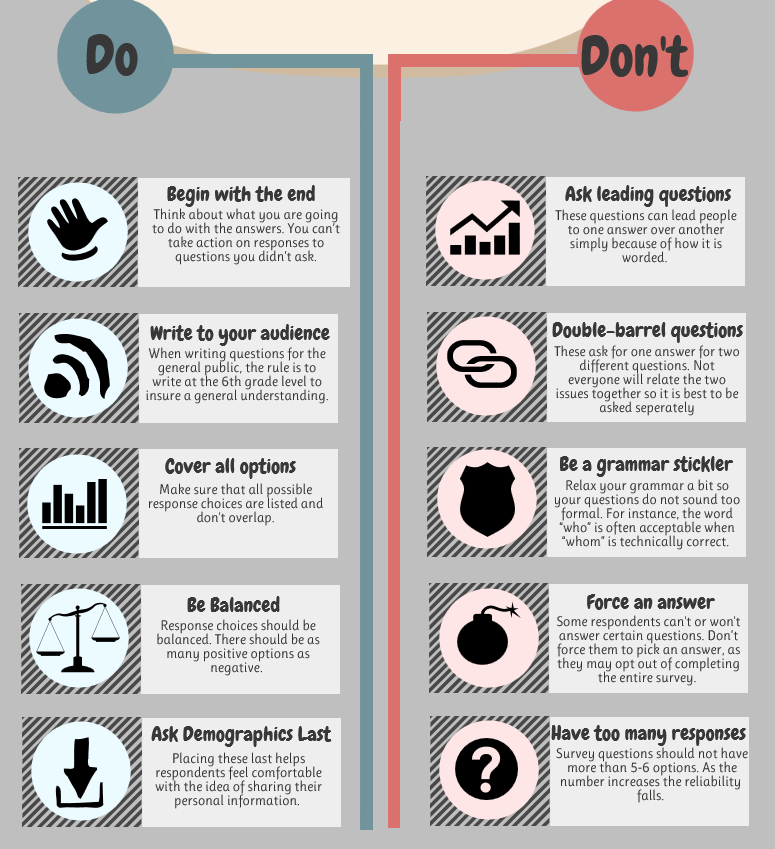
But the decisions don’t end there! You’ll also have to decide how to ask your questions. Here’s Do’s and Don’ts for writing Survey questions to guide you to creating an effective survey that will get better results. All of the main points are very important and make it easier to come up with questions for a survey.
Remember that “Good Survey Questions Take Time” Surveying takes careful planning. Doing the hard work up front will save you time and effort later. Good survey questions lead to good results!
No survey can achieve success without a well-designed questionnaire. Unfortunately, questionnaire design has no theoretical base to guide the researcher in developing a flawless questionnaire. All the researcher has to guide him or her is a lengthy list of do’s and don’ts born out of the experience of other researchers past and present. Hence, questionnaire design is more of an art than a science.
What is survey research?
A Survey is defined as a research method used for collecting data from a pre-defined group of respondents to gain information and insights on various topics of interest. Surveys have a variety of purposes and can be carried out in many ways depending on the methodology chosen and the objectives to be achieved.
The data is usually obtained through the use of standardized procedures whose purpose is to ensure that each respondent is able to answer the questions at a level playing field to avoid biased opinions that could influence the outcome of the research or study. A survey involves asking people for information through a questionnaire, which can be distributed on paper, although with the arrival of new technologies it is more common to distribute them using digital media such as social networks, email, QR codes or URLs.
If you are finding it hard to think of good questions to ask, this may be just the thing you need! It provides for you five basic steps to consider when trying to develop thoughtful questions for your survey.
The first step is named “Focus”. This step asks you to consider what it is you really want to know and the depth of the question.
The second step, the purpose, is to consider why you are asking the question and whether you need facts or opinions.
The third step, intent, asks you to ponder what you will do with the information you receive.
The fourth step is to analyze the frame of the question by making sure you are using easily understandable terms.
The fifth and last step is to follow-up.
These five steps will make it much easier for you to develop questions for your survey. They will also make sure to eliminate what is not necessary and get straight to the point. This will allow users to understand the survey better, which will encourage them to respond!
You might think that questionnaire design is rather simple and easy; after all, it’s just a list of questions right? However, a proper questionnaire structure is one of the most vital steps in achieving successful results with your research. A good design will help respondents complete your survey, as you should never underestimate the power of something aesthetically pleasing! Read on to find out how a well-planned format for your survey will improve the accuracy of the data you collect…
The following provides you with guidelines for conducting your surveys:
Write a short questionnaire
Above all, your questionnaire should be as short as possible. When drafting your questionnaire, make a mental distinction between what is essential to know, what would be useful to know and what would be unnecessary. Retain the former, keep the useful to a minimum and discard the rest. If the question is not important enough to include in your report, it probably should be eliminated.
Use simple words
Survey recipients may have a variety of backgrounds so use simple language. For example, “What is the frequency of your automotive travel to your parents’ residents in the last 30 days?” is better understood as, “About how many times in the last 30 days have you driven to your parent’s home?”
Relax your grammar
Relax your grammatical standards if the questions sound too formal. For example, the word “who” is appropriate in many instances when “whom” is technical correct.
Assure a common understanding
Write questions that everyone will understand in the same way. Don’t assume that everyone has the same understanding of the facts or a common basis of knowledge. Identify even commonly used abbreviations to be certain that everyone understands.
Start with interesting questions
Start the survey with questions that are likely to sound interesting and attract the respondents’ attention. Save the questions that might be difficult or threatening for later. Voicing questions in the third person can be less threatening than questions voiced in the second question. For example, ask: “How do your colleagues feel about management?” rather than “How do you feel about management?”
Don’t write leading questions
Leading questions demand a specific response. For example: the question “Which day of the month is best for the newly established company-wide monthly meeting?” leads respondents to pick a date without first determining if they even want another meeting.
Avoid double negatives
Respondents can easily be confused deciphering the meaning of a question that uses two negative words.
Balance rating scales
When the question requires respondents to use a rating scale, mediate the scale so that there is room for both extremes.
Don’t make the list of choices too long
If the list of answer categories is long and unfamiliar, it is difficult for respondents to evaluate all of them. Keep the list of choices short.
Avoid difficult concepts
Some questions involve concepts that are difficult for many people to understand.
Avoid difficult recall questions
People’s memories are increasingly unreliable as you ask them to recall events farther and farther back in time. You will get far more accurate information from people if you ask, “About how many times in the last month have you gone out and seen a movie in a movie theater or drive-in?” rather than, “About how many times last year did you go out and see a movie in a movie theater or drive-in?”
Use Closed-ended questions rather than Open-ended ones
Most questionnaires rely on questions with a fixed number of response categories from which respondents select their answers. These are useful because the respondents know clearly the purpose of the question and are limited to a set of choices where one answer is right for them.
An open-ended question is a written response. For example: “If you do not want a company picnic, please explain why”. If there are an excessive number of written response questions, it reduces the quality and attention the respondents give to the answers.
However, InfoPoll allows you to use a wide variety of other types of questions.
Put your questions in a logic order
The issues raised in one question can influence how people think about subsequent questions. It is good to ask a general question and then ask more specific questions. For example, you should avoid asking a series of questions about a free banking service and then question about the most important factors in selecting a bank.
Pre-test your survey
It is better to identify a problem during the pretest than after you have published the survey. Before sending a survey to a target audience, send it out as a test to a small number of people. After they have completed the survey, brainstorm with them to see if they had problems answering any questions. It would help if they explained what the question meant to them and whether it was valid to the questionnaire or not.
Naming your survey
Some people discard an electronic message based entirely on its subject or sender. You should consider other titles that will pique the interest of the recipients. Here are examples of survey names that might be successful in getting attention:
Memo From the Chief Executive Officer
Evaluation of Services of the Benefits Office
Your Opinion About Financial Services
Free T-shirt
Win a Trip to Paris
Please Respond By Friday
Free Subscription
Win a notebook computer
Cover memo or introduction
Once a recipient opens your survey, you may still need to motivate him or her to complete it. The cover memo or introduction offers an excellent place to provide the motivation. A good cover memo or introduction should be short and includes:
Purpose of the survey
Why it is important to hear from the correspondent
What may be done with the results and what possible impacts may occur with the results.
Address identification
Person to contact for questions about the survey.
Due date for response
Send it to a few people, maybe your colleagues, friends or family. You will not count their responses into the results, but they will help you to validate that all of the included questions are understandable, that your survey doesn’t contain any unclear answer choices, and that the survey doesn’t lead to a dead end. It’s better to look awkward in front of a few friends than to end up with a useless survey results.
A great vocabulary is just one essential tool in a writer’s toolbox, along with punctuation, grammar, and many others. Vocabulary can make your writing more powerful and more effective and help you say exactly what you mean. This indispensable tool will help you choose the best word for every job and avoid vague words that do not give your readers a good sense of your meaning.
Building your vocabulary is one of the easiest ways to improve the power of your writing and make any writing task that much easier, as you will have several synonyms in your repertoire to pull from every time. Developing your vocabulary need not be difficult or painful.
Let’s have a bit of practice
Enriching your vocabulary is not as hard as you might think. You don’t need any special skills; you need to rely on systematic practicing instead – it’s a miracle worker. With every bit of effort, your knowledge becomes better and better. That’s exactly what you want, isn’t it?
For this reason we encourage you to read the following ten helpful tips for self-training and learning new vocabulary units effectively:
Make a practice schedule. It will be more effective, if you practice every day. In case you are short of time, try to practice every other day. Define what time of the day is good for you, what methods are best for you (stated below). Vary the learning techniques.
Read a challenging book, choosing anything you like: science, fiction, adventure, fantasy, biography. Read at least 20 pages a day. If you have a chance to read more than that, by all means, do it.
Select top-grade newspapers and magazines according to your interests and read daily. You probably have your favorite magazines, so it won’t be hard to find something great ones to read.
Write down unfamiliar words. While studying, you are sure to come across a lot of them. Write them down in a small notebook, grouping all the noted vocabulary units according to spheres of usage, frequency, etc. Keep it handy to make notes any time you need. Remember to review these word notes from time to time.
Read speeches of famous personalities (e.g. political leaders)to learn from great public speakers. You will boost your confidence and be able to speak spontaneously. This will be to your advantage at seminars, oral exams or presentations.
Join a book or writing club. Working in a group is a good alternative to individual learning. Attempts to be equal to your peers (or be even better) is a challenge – and as you know, challenge leads directly to success.
Practice writing. Try to write different things – letters, short stories, poems … If you don’t really enjoy writing, think of it as an exercise and do it for learning purposes only. If you love writing, well, it’s going to be a great way to spend your time – both with pleasure and efficiency.
Do vocabulary exercises. For instance, try these two sites, where fun and strategic exercises give you online practice in a low-key way: Free Rice and Vocabulary.com.
Install a dictionary app on your cell phone. With a quick swipe, you can check out an unknown word in no time.
And the last tip, but not the least: just use a dictionary – paper or online, it doesn’t really matter. Make a habit of suing a dictionary. Look up the meaning or pronunciation of the new words. If you have time, look through dictionary pages – you’d be surprised at the useful words to be discovered.
Here is a list of the most helpful online dictionaries, so you can learn how to speak easily:
Visual Thesaurus (maps of related words, so you can understand the word family connections between them)
Wiktionary (definition, etymology, equivalents in other languages)
Webopedia (definitions of terms, related terms)
Dictionaty.net (database of word and phrase definitions from eight different sources)
Hopefully, this list has given you an excellent place to start to build your vocabulary a bit at a time. If you think about it, there are opportunities all around you to develop this important skill, so spend time every day reading and listening to take in new words and then develop a system to incorporate these new words in your writing and speech. Before long, you’ll find your vocabulary has grown to a new level and your writing has gained the clarity you need with an ease you didn’t think possible.
Research paper sources can be difficult to find – especially if you want the good ones.
Find some creative ways to make your research paper interesting. Research papers can be fascinating and enjoyable, especially when you dig up unique and noteworthy research paper sources.
Here are 6 quick tips that will help you do fast, effective research, and find great research paper sources that will set you apart from your classmates.
Steps to writing a research paper
1. Investigate possible topics
Once you know there will be a required research paper to receive credit for the class, go to the campus library and investigate possible topics. See what sources are available. Talk with the librarian and ask which topics are popular for that class. Do not expect the librarian to perform all your research but the staff can offer great tips and point you in the right direction. Armed with this information will put you days ahead of your classmates.
2. Choose your topic
After the assignment has been given, immediately choose your topic and have the instructor approve it. Once approved it is time to outline your research strategy. This is where the previous time in the library is invaluable – you know what sources are immediately available – books, newspaper and magazine articles, documentaries, journals, etc. The most important part of this step is to once again plan ahead.
We’ve all heard the story about the race between the tortoise and the hare. The hare took off from the starting line in a flash and hopped way ahead of the tortoise. The hare got so far ahead he decided to take a lunch break. Meanwhile, the tortoise just kept plodding along. The hare made fun of how slow the tortoise was moving. The race was long so the hare knew he had plenty of time to beat the tortoise – so the hare goofed off some more. When the hare came bounding up to the finish line he was shocked to see the tortoise. The morale of the story is simple – plan ahead and keep moving towards your goal.
3. Write a thesis statement
Once you have outlined the sources you will be using then plan when you will have each portion of the research completed. Place a date beside each source. Then prior to beginning your research draw up a rough outline so you will stay focused. Once you have a firm grasp on your topic write a thesis statement.
A thesis statement is one or more sentences explaining the point of your academic paper. It tells what your paper is about, the point it will make, how it will reach this point, the methods used to prove this point, and the conclusion drawn once all the evidence is in. Your thesis statement should tell the reader what the paper is about, where it is going and how it will get there.
While writing a thesis statement, you may want to try the stream of consciousness technique. Let your ideas flow and write down everything that comes to your mind on the topic. You can then re-read all thoughts and format your thesis statement from a draft.
By planning ahead and being armed you will not waste a lot of time investigating information that pertains to your topic but is not the focus of your research project.
4. Keep notes on your source’s information
The larger the research project the more notes you will have to keep everything organized either by source, by your paper’s outline, or some other method that allows you to find information when it is needed. Also keep extensive notes on your source’s information – author, publication date, publisher, etc., — cite information that will be needed for your reference list at the end of your academic paper.
5. Set a date to start writing your paper
This brings up the final two parts to planning ahead. Set a date when you will start writing your paper and begin that day – no procrastination. This date must be firm, fixed, and adhered to. Put the first words down on your rough draft document. Try and write your overall intro in one sitting. This gives you a short working draft of your whole paper in one complete thought – a good visual. This intro is like an early warning signal that will inform you of any holes you might have in your outline or research material. The earlier the holes are caught the easier it will be to complete your research project on time and avoid the temptation of copying and pasting information that could potentially lead you to plagiarize.
6. Set a date for your final edits
Finally, set a date for your final edits – ideally a few days before the project is due.
If you get enough research paper resources while following these tips to make them interesting and unique, and I’m confident your research paper will stand out from your classmates.
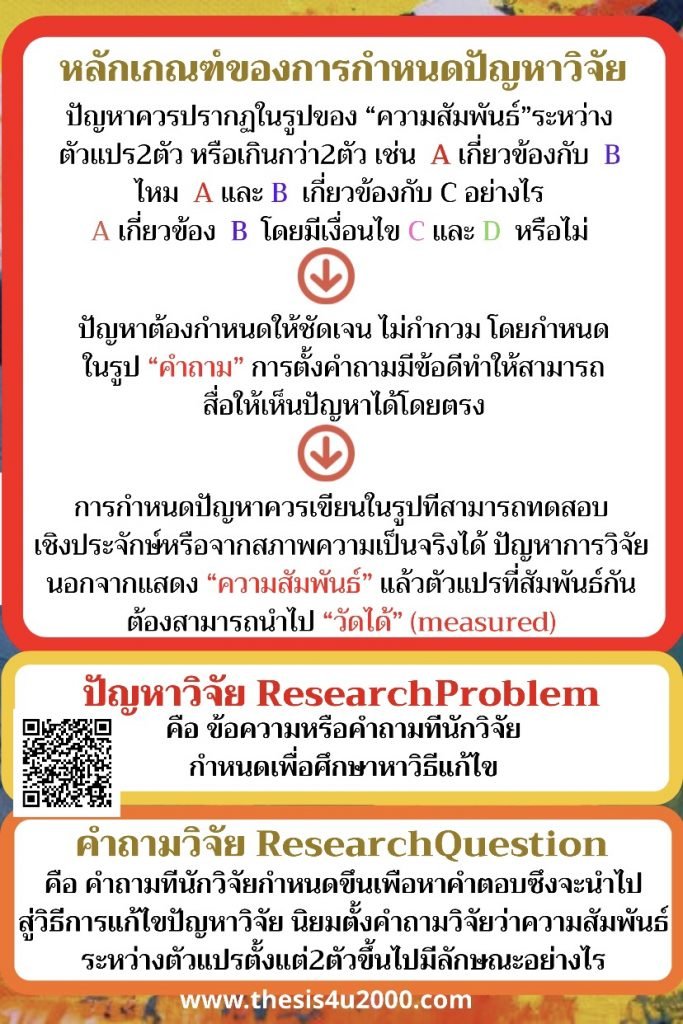
1. ปัญหาควรปรากฏในรูปของ “ความสัมพันธ์” ระหว่างตัวแปรสองตัว หรือเกินกว่าสองตัว เช่น A เกี่ยวข้องกับ B ไหม A และ B เกี่ยวข้องกับ C อย่างไร A เกี่ยวข้อง B โดยมีเงื่อนไข C และ D หรือไม่
Many players weighing new gaming sites end up comparing welcome packages, live dealer lobbies, and withdrawal speeds before signing up, and platforms like Cazeus Online Casino often show up in those side-by-side reviews. A short check of licensing credentials, available payment methods, and the variety of slot providers tends to separate the better regulated brands from the rest of the pack, so it is worth scanning the footer details and the terms page rather than just the promo banner. For anyone interested in trying Cazeus Online Casino, reading recent player feedback and noting the minimum deposit and wagering requirements usually gives a clearer picture than the headline bonus number alone.
Wie je live tafels wilt verkennen zonder gedoe, dan kan een account met snelle verificatie en heldere stortingslimieten helpen; wie liever sport en slots combineert, vindt via stake casino een overzichtelijke Nederlandstalige omgeving die aan alle eisen voldoet.